Table of Content
What is Magento E-commerce Development?
Every e-commerce store or website requires an all-in-one platform that helps in managing multiple operations.
Magento E-commerce website development platform is designed for efficient store design, catalog, user management, payment gateway integration, and search engine optimization.
People often confuse Magento E-commerce Development with Magento web and website development.
However, all three pertain to different needs. Here is a brief overview of what Magento website development and Magento web development are.
- Magento website development is a broader category that includes any website developed on the Magento platform. It can be an e-commerce website, a simple portfolio website, or anything else.
- Magento web development includes custom coding, API integration, and back-end development.
If this information intrigued you, then let us dive deeper into this guide on Magento E-commerce Development. Here we will cover the steps to set up a Magento store, primary features you can consider, development challenges, and more.
Who Should (and Should NOT) Use Magento?
The Magento E-commerce platform has lots of features suitable for different business sizes working in different industries. However, it is more beneficial for some than others. Let us have a look.
Ideal for:
- Scaling ecommerce brands: Organizations that are constantly growing into the e-commerce market with a large user base should try Magento for its advanced analytics and custom features.
- Large product catalogues: Brands selling a large number of product catalogues, meaning there’s a lot of data to be processed. For example, information like product descriptions, images, reviews, etc., needs to be stored and processed in real-time.
- Custom workflows: Businesses requiring custom workflows for a smoother cart checkout experience and other functions should switch to custom Magento development.
Not ideal for:
- Small businesses with limited budgets: Magento can be slightly expensive for small businesses with tight budgets that have just started out. Hosting, development, and maintenance charges can feel heavy for small startups at the early stage.
- Simple stores with basic needs: You do not need the Magento platform for a small and simple store where only basic functionalities are required.
Magento vs Shopify & WooCommerce: Which One Is Better?
Over 1,00,000 e-commerce websites worldwide are built on Magento, and it comes with the highest number of plugins and extensions.
Before making up your mind, here is a detailed comparison of Magento with Shopify and WooCommerce.
Flexibility & Customization
A growing business requires a platform that makes adding new categories and products an easy task. Magento follows a modular architecture that helps tailor the online store without complicating the process.
Magento stores can scale efficiently without platform limitations, which makes adding new features and products very easy.
Cost Comparison
Magento, Shopify, and WooCommerce each have their own unique structures. Magento is known for its flexibility, but that comes with a hefty price tag for development and hosting.
On the other hand, Shopify operates on a subscription model, which means you can expect consistent monthly fees. WooCommerce starts off free, but you'll need to budget for hosting, themes, and plugins, which can add up depending on how your business grows.
Scalability
Magento can effortlessly support large catalogs, handle high traffic, and accommodate enterprise-level growth without breaking a sweat. Shopify does a decent job with scaling, but it does have its limits, and WooCommerce might find it tough to keep up with very large stores.
Thanks to its solid architecture, Magento stands out as the go-to option for e-commerce businesses that are rapidly expanding and dealing with high volumes.
Ease of Use
Magento development requires technical knowledge, which can be daunting for beginners. However, you can always hire expert Magento developers like PSDtoHTMLNinja to take over the complete development work.
Businesses seeking advanced control should use Magento for better results and high-end store management.
Shopify, on the other hand, is the easiest to use as it comes equipped with a large repository of Shopify themes and templates, along with plugins. WooCommerce is moderately difficult but can be managed if you are familiar with WordPress.
| Feature | Magento | Shopify | WooCommerce |
|---|---|---|---|
| Flexibility & Customization | Highly Customizable | Midly Customizable | Customizable within the WordPress environment |
| Cost | Mid to high cost range | Mid-range | Mid to high cost range |
| Scalability | Grows with your business | Moderately scalable | Limited scalability options |
| Ease of Use | Slightly complicated | Easy to use | Moderately difficult usage |
Magento Web Development: What Actually Goes Into It?
Since we are looking at the guide on Magento development, it is essential to consider every aspect of the process. Magento web development is not only about creating a store, a lot more technical layers to bring scalability and flexibility.
Frontend Development
Frontend development is employed to craft user-friendly, responsive, and lightning-fast interfaces. With Magento frontend development, you can expect seamless navigation, optimized experiences for mobile users, and visually captivating storefronts that really boost conversions.
Backend Development
Developers use backend development to create custom modules, set up the business logic, and design the architecture to handle intricate workflows, all while ensuring that the system remains flexible and scalable.
Third-Party Integrations
When it comes to Third-Party Integrations like ERP, CRM, and various APIs, Magento does a fantastic job of connecting with external systems. This means you can streamline your operations and boost your business efficiency all in one go.
Performance Stack
Magento is equipped to tackle heavy traffic and data loads. It employs cutting-edge caching methods, CDNs, and optimization strategies to guarantee that users enjoy a fast and dependable experience.
Magento Store Development Process
Developing a Magento store involves following well-structured technical processes along with solid research and workflow planning. We have laid out a clear and tested development process that helps in creating a fully-functional and user-friendly Magento store.
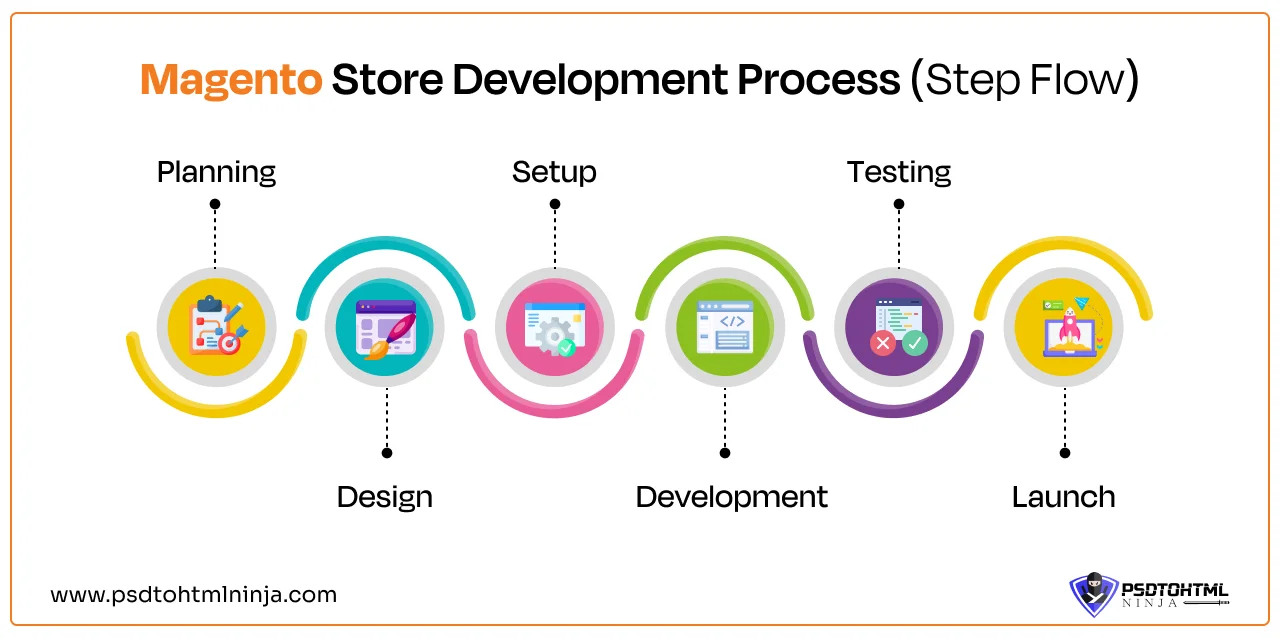
Step 1: Business & Technical Planning
The first step is to define your goals and identify the real reason behind choosing Magento as your e-commerce platform.
For example, you choose Magento for advanced analytics and high-end features. To achieve this, your technical plan should move in the right direction.
It is important to pinpoint your target audience at this stage. This way, your roadmap can outline the right steps to effectively reach and serve them.
Common mistakes to avoid: Include the budget and timeline at the very beginning of your Magento store development process. Always hire an expert Magento development company for the best results.
Step 2: Store Architecture & UX Strategy
Your next move is to craft the basic store architecture and user design. This includes selecting or modifying a Magento theme that meets your expectations and business requirements.
This includes identifying key elements like the website structure, font style and size, navigation menus, search bars, and everything that delivers a perfect user experience.
Make sure the store architecture supports multiple device compatibility for tablets, mobile phones, and other devices, since most online customers shop on their smartphones.
Step 3: Magento Setup & Environment
Step 3 of the development process involves setting up the Magento store and adding the required functionalities.
- Install Magento
- Set up hosting: You would need to set up cloud hosting since shared hosting provided by Magento will not be enough, especially for large stores.
- Set up Server Stack Configuration, configure cache and performance setups.
Step 4: Custom Development & Integrations
Once your Magento store is all set up, it is time to make all the required modifications. This includes setting up the SEO features like fixing the metadata, adding SSL, integrating third-party payment gateways, and other custom modules and features to support unique business needs.
Other additions include:
- Shipping providers
- Marketing tools
- Sitemaps
Step 5: Testing (Performance, checkout, UX)
Now that you have added the custom features, testing the store for performance is extremely crucial before it goes live.
- Performance testing: Run the store on different devices to ensure cross-device functionality and cross-browser functionality. Test the web page loading speed, and make sure that all website elements load quickly.
- SEO testing: Make sure the metadata is optimized, images have alt text, and all the URLs follow the correct structure.
- Cart checkout: Perform cart checkout to ensure it's smooth, and no errors occur.
Fix all the errors that arise during this testing stage.
Step 6: Launch & Post-Launch Optimization
Now that you are satisfied with your Magento store, you can launch it on the servers. Monitor the store after launching it and make all the necessary changes if you notice anything unusual.
Magento Ecommerce Development Cost (Transparent Breakdown)
How much does it cost to develop a Magento E-commerce store? If you are wondering the same thing, then allow us to give you a realistic cost breakdown.
The factors mentioned below are identified based on the latest Magento market trends and professional costings.
Key Cost Factors
- Features & complexity: Whether you want advanced features or the basic functional specifications are enough. The more complicated the Magento development process, the higher the cost.
- Design requirements: Using an existing Magento theme is much cheaper than setting up a custom design for your Magento store. Additional costs are incurred with advanced design options.
- Integrations: Integrating APIS, third-party apps, and payment gateways leads to additional costs. Make a list of all the integrations you want in your e-commerce store.
- Developer expertise: Hiring expert Magento developers is costlier than working with a freelance developer or developing a Magento store manually. However, trusting a reliable developer is recommended for the best results.
Estimated Cost Ranges
| Store Size | Cost Range |
|---|---|
| Small Store | $1000 - $5000 |
| Mid-size Store | $5000 - $15,000+ |
| Enterprise Store | $10,000 - $50,000+ |

Types of Magento Website Development Services
Magento website development is further divided into multiple services bought for different purposes. Here is a more detailed understanding of these services:
Magento Ecommerce Store Development
- Includes complete E-commerce store development.
- Cart management, navigation menus, product details.
- High-quality images, marketing, and analytics tool integration.
Custom Magento Development
- Customizing existing Magento stores
- Creating brand-new custom Magento stores
- Adding customized functionalities for better performance
Magento 2 Development
- Building scalable stores and websites using Magento 2
- Ensuring high webpage loading speed
- Making the website mobile-friendly and cross-browser compatible
Migration Services (Shopify, WooCommerce, Magento 1)
- Migrating from the existing E-commerce platform to Magento.
- Transferring all website data to Magento
- Improved store performance post-migration
- Speed optimization of the migrated e-commerce store
Headless Magento Development
- Building efficient strefronts using the Headless architecture
- Custom user experiences and mobile-friendly stores
- Advanced feature integration using the modern frameworks
Maintenance & Support
- Ongoing maintenance for a smooth store performance
- Regular updates and security patches
- Bug fixes, performance monitoring, and timely store optimization
Magento Open Source vs Adobe Commerce (Which One to Choose?)
When it comes to choosing between Magento Open Source and Adobe Commerce, it depends on the size of your business, your budget, and how complex your needs are.
Feature Comparison
Magento Open Source gives you the essential e-commerce tools like product management, basic SEO, and a straightforward checkout process. On the other hand, Adobe Commerce, which is the paid version, packs in some powerful extras like AI-driven product recommendations, customer segmentation, B2B capabilities, content staging, and advanced analytics.
Cost Comparison
Magento Open Source is free to use, but you will need to invest in development, hosting, and extensions. Adobe Commerce, while it comes with licensing fees that make it pricier, offers built-in enterprise-level features and cloud infrastructure through Adobe Commerce Cloud.
When to Choose Which One
If you are a small to mid-sized business with some development support and you want flexibility without breaking the bank upfront, Magento Open Source is the way to go. On the other hand, if you need advanced features, scalability, and dedicated support, Adobe Commerce is your best bet.
Ideal For
Open Source is perfect for startups and growing brands that have simpler needs. Meanwhile, Adobe Commerce shines for large enterprises, B2B companies, and brands that are dealing with complex operations, high traffic, and aiming for global growth.
Common Magento Development Challenges (And How to Solve Them)
Magento is a powerful tool, but it needs to be used correctly to develop a smooth and new-age E-commerce store.
High Development Costs
When it comes to Magento development, costs can really add up, especially with all the customization and infrastructure requirements.
Solution: To keep expenses in check, focus on the essential features, opt for trustworthy pre-built extensions instead of creating everything from the ground up, and consider a phased development strategy to spread out your investments over time.
Performance Issues
Slow loading speed of the website can affect the online traffic.
Solution: Implement advanced caching solutions, optimize your images and code, and select a high-performance cloud hosting service that supports CDN to manage traffic effectively.
Maintenance Complexities
Keeping your Magento store running smoothly is a complex task that requires regular updates, security patches, and performance monitoring.
Solution: Invest in ongoing maintenance and support services to avoid downtime, enhance security, and ensure your store remains optimized as your business expands.
Finding Expert and Skilled Developers
Magento store development requires the right expertise. But how do you find a reliable Magento developer?
Solution:
- Hire certified developers
- Look for local testimonials and online reviews
- Check their team’s expertise
- Carefully analyze their portfolio
Magento SEO & Performance Best Practices
Magento stores are highly functional and offer optimized performance, especially when it comes to meeting the SEO requirements.
However, SEO trends change overnight, and your store should be equipped enough to combat these challenges. Here is a list of the best SEO and performance tips to enhance the functionality of your e-commerce store:
- SEO-friendly URL structure: Keep a check on the URL structure of all your webpages. They should be fully optimized to meet the latest SEO standards.
- Core Web Vitals optimization: Improve the loading speed and interactivity of your website by adding useful features and ensuring smooth navigation.
- Technical SEO setup: Make sure to configure the XML site maps and canonical tags to ensure the search engine easily crawls the website.
- Speed optimization (caching, images, CDN): Compress the images and enable caching for improved website performance.
When Should You Hire a Magento Development Company?
When do you need the assistance of a Magento Development company? The requirement of experts arises in several distinct cases, especially when the store requires integration of complex features. We have listed down the primary scenarios where hiring a professional Magento development company will make sense.
When project complexity increases
Certain projects require the assistance of highly trained and skilled experts. A professional Magento development company will manage all the complexities with great precision and excellence. From adding extremely complex features to managing the SEO aspects of your store, everything will be handled by the experts.
When scaling your store
Businesses wanting to scale their e-commerce store to meet their growing requirements should hire a development team. These professionals will manage the higher traffic volume, a large repository of product catalogues, and multiple payment gateways.
When performance issues arise
Sometimes an e-commerce store has core issues because of which errors like slow loading speed, website downtime, and low online traffic keep on occurring. Investing in a Magento Development service will be the best decision to fix these performance issues.
Future of Magento Ecommerce Development
Magento E-commerce development is constantly evolving. With new technologies being introduced frequently, businesses are searching for a scalable and futuristic E-commerce store, which Magento successfully delivers.
Headless commerce
Headless commerce is really taking off, especially with Headless Magento, which separates the frontend from the backend. This setup enables businesses to create faster and more personalized experiences across various platforms, including web, mobile, and the latest digital channels, all thanks to APIs.
Progressive Web Apps (PWA)
Magento PWA brings app-like experiences to life, offering quicker load times, offline access, and enhanced mobile performance. These PWAs not only boost user engagement but also drive conversions, making them a standout trend in today’s ecommerce landscape.
AI-driven personalization
With the power of AI and machine learning, Magento stores are transforming. They can now offer personalized product recommendations, dynamic pricing, and targeted marketing campaigns. This approach helps businesses keep customers coming back and ultimately increases sales.
Composable commerce
Composable commerce empowers businesses to create modular ecommerce systems by integrating top-notch services. Magento embraces this strategy with its flexible APIs, allowing brands to grow and innovate without being tied down to a rigid framework.
Conclusion
Magento ecommerce development is a strong choice for businesses that need flexibility, scalability, and full control over their online store. From handling large product catalogs to supporting complex integrations, Magento enables long-term growth without platform limitations.
However, building and managing a Magento store requires the right technical approach, planning, and ongoing optimization to achieve the best results.
If you're planning to build or scale your store, working with an experienced team can make a significant difference. PSDtoHTMLNinja offers reliable Magento development support tailored to your business needs.
FAQs (Featured Snippet Target)
1. What is Magento ecommerce development?
Magento E-commerce Development is the process of building online stores for e-commerce businesses.
2. How much does Magento development cost?
The cost of Magento development depends on a series of factors like additional features, website design and layout, theme, performance optimization, SEO, etc. Contact a reliable Magento development agency for a fair price quote.
3. Is Magento better than Shopify?
Brands that prioritize advanced performance, premium tool integration, and smooth cart management choose Magento over Shopify because of its framework, scalability, and easy integration possibilities.
4. How long does it take to build a Magento store?
The exact timeline depends on the project complexity and whether you have hired a Magento Development company. Factors like the store size, feature requirement, etc., play a key role in identifying the development time.
5. Is Magento good for SEO?
Yes, Magento allows you to develop an SEO-friendly store that ranks well on search engines.

Jayveer Ker serves as the Business Development Manager at PSDtoHTMLNinja.com, specializing in assisting organizations with overcoming web development hurdles. His insightful and informative posts deliver practical solutions and valuable insights.
Couldn't find what you were looking for?
Let us know how we can help!