Table of Content
Quick Answer: How Much Does Shopify Cost?
Shopify offers subscription plans ranging from $39/month for the Basic plan to $2,300+/month for Shopify Plus. However, the actual cost of running a Shopify store goes beyond the monthly subscription fee.
Additional expenses such as premium themes, apps, payment processing fees, email marketing tools, and shipping solutions can significantly impact your overall Shopify budget.
Estimated Shopify Monthly Costs by Business Type.
| Business Type | Estimated Monthly Cost |
|---|---|
| Startup Store | $50–$75 |
| Small Business | $155–$230 |
| Growing Ecommerce Brand | $500–$900 |
| Enterprise Store | $3,500–$7,500+ |
Whether you're launching a new ecommerce store or migrating to Shopify from platforms like WooCommerce, Magento, BigCommerce, or Wix, understanding the full cost picture is essential. While Shopify subscription fees are easy to compare, additional expenses such as themes, apps, payment processing, and store migration requirements can significantly influence your overall budget.
In this guide, we'll break down Shopify pricing plans, transaction fees, hidden costs, and real-world examples to help you estimate the actual cost of running a Shopify store.
Shopify Pricing Plans & Monthly Costs at a Glance
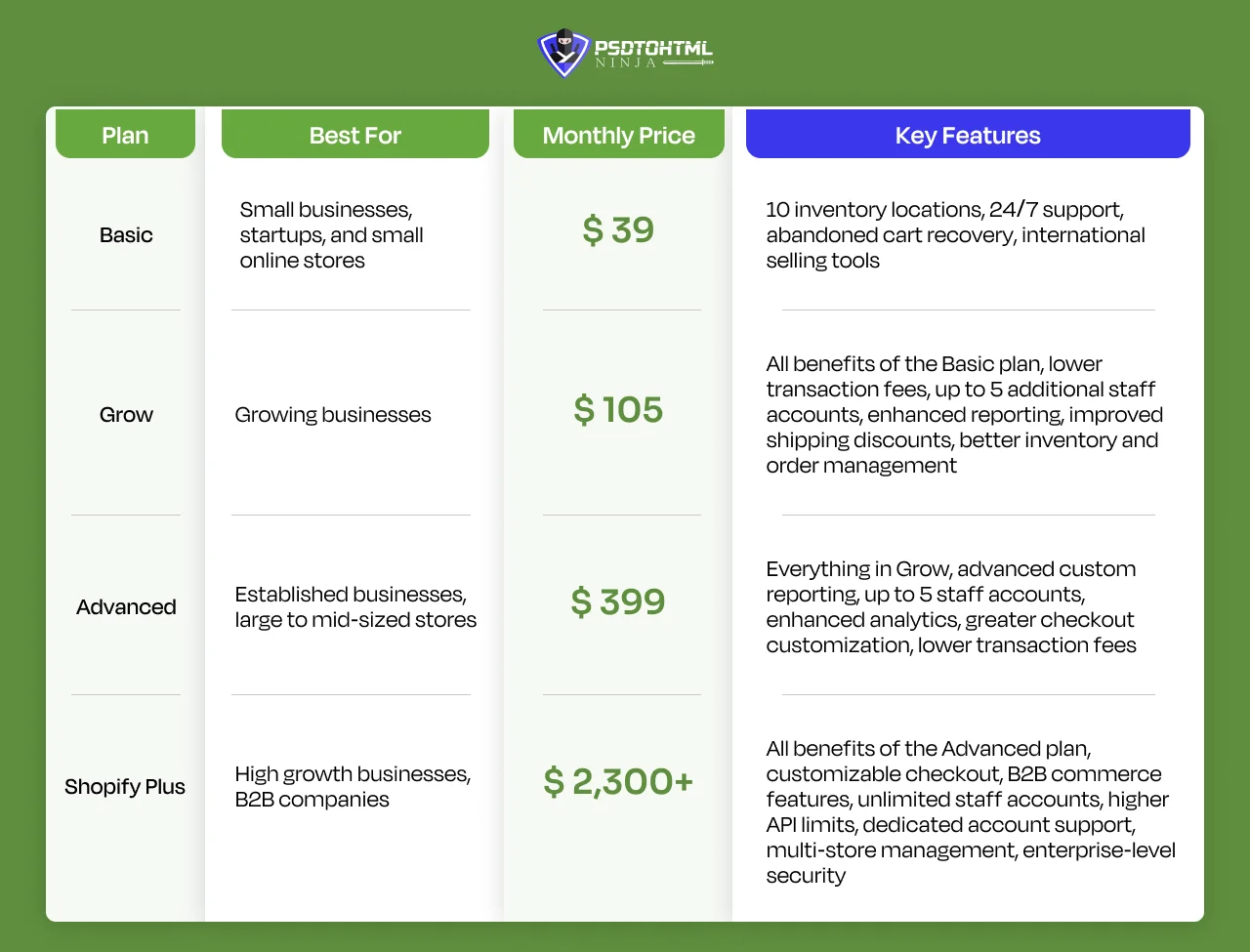
Shopify offers 4 major plans that come with a 3-day free trial. We have created a comprehensive list of all the plans with their requirements and usage.
This detailed table highlights the best usage and primary features of the different Shopify plans.
Shopify Pricing Plans Explained
Basic Shopify Plan
This is the entry-level Shopify plan that comes with exciting features and benefits, like managing your inventory, 24/7 support, a customizable online store, shipping discounts, and more.
- Monthly price: $39
- Features included: Customizable store, abandoned cart recovery, international selling tools, Shopify payments.
- Ideal for: Small businesses and startups with a limited user base.
- Pros: Affordable and offers customization options.
- Limitations: Customization options are somewhat limited.
Shopify Grow Plan
This plan is designed for small businesses with growth potential. It offers benefits like higher shipping discounts, detailed reporting, and more.
- Monthly price: $105
- Features included: 5 staff accounts, advanced analytics tools, up to 88% shipping discounts, checkout customization
- Ideal for: Small businesses that are growing rapidly
- Advantages over Basic: Better inventory and order management, smoother performance
Shopify Advanced Plan
Used by many mid-sized and large businesses, the Advanced plan comes with features like advanced reporting, higher customization, and up to 15 staff accounts.
- Monthly price: $399
- Features included: Third-party calculated shipping rates, checkout customization, lower transaction fee.
- Ideal for: Established brands that are earning revenue
- Advantages over Grow: Custom reporting, higher number of staff accounts
Shopify Plus
The plan was launched for high-end businesses, large enterprises, and established brands. It offers large-scale store management for simplified workflow. The plan comes with B2B capabilities for easy wholesale selling.
- Enterprise pricing: $2300+
- Ideal For: Large enterprises
- Features: B2B commerce features, unlimited staff accounts, multi-store management
- Benefits: Advanced automation, higher API limits, higher security
How Much Does Shopify Cost Per Month?
A Shopify monthly cost depends on various factors, including the store size, custom requirements, business size, theme (free or paid), hosting type, etc.
For better understanding, here are some real-world examples of the estimated monthly costs for different types of Shopify stores.
Example 1: Startup Store
This setup is perfect for entrepreneurs, creators, and small businesses ready to launch their very first online store. It includes all the must-have e-commerce features while keeping expenses in check.
Most startup stores typically opt for a free theme and just a few essential apps to test their products and start building a customer base.
- Ideal Shopify plan: Basic plan costing $39 per month
- Domain: About $20 per year
- Basic apps: $10 – $30/month (reviews, SEO, analytics, etc.)
- Estimated Monthly Budget: $50–$75/month
Example 2: Small Business Store
A small business store usually caters to brands that have built a loyal customer base and are looking for more sophisticated tools to fuel their growth.
These businesses often turn to marketing automation, customer retention strategies, and analytics platforms to boost their sales performance.
With these added features, they can streamline their operations and create a better overall shopping experience for their customers.
- Plan: Grow plan costing up to $105 per month
- Marketing tools: Marketing tools are estimated to be $20-$50 per month
- Apps: $30 – $75/month (reviews, loyalty programs, upselling, analytics)
- Estimated Monthly Budget: $155–$230/month
Example 3: Growing E-commerce Brand
Growing e-commerce brands often juggle larger product catalogs, handle higher traffic, and navigate more intricate business operations. These companies invest in top-notch applications, detailed reporting, and advanced marketing tools for enhanced customer acquisition and retention.
Their technology setup is usually crafted to ensure scalability and foster long-term growth.
- Plan: Advanced, costing $399 per month
- Premium apps: Subscriptions, reporting, and inventory management apps costing $100 - $300 per month
- Email marketing: About $50 - $200 depending on the subscriber volume
- Estimated monthly budget: $500 - $900 per month
Example 4: Enterprise Shopify Store
These stores operate on a grand scale, often juggling multiple brands, regions, or sales channels all from one central hub. They depend on custom integrations, automated workflows, and robust infrastructure designed for complex operations.
Their investment goes well beyond just the Shopify subscription; it also includes advanced software, dedicated support, and tailored development services.
- Plan: Shopify Plus
- Advanced integrations: Custom APIs, CRM, marketing tools. $1000 - $3000+
- Large app ecosystem: Depends on the needs, but the cost ranges between $500 and $2000 per month
- Estimated monthly budget: $3500 - $7500 per month
Expert Insight from PSDtoHTMLNinja
Having worked on Shopify projects for businesses across various industries, we've found that most store owners focus heavily on Shopify subscription fees while overlooking other expenses such as premium apps, email marketing tools, payment processing charges, and ongoing optimization costs.
In many cases, these additional expenses exceed the monthly Shopify plan cost itself. Understanding these costs upfront can help you create a realistic ecommerce budget and avoid unexpected expenses as your store grows.
Shopify Fees Explained
The long list of cost factors can easily confuse anyone. So, what are the exact Shopify fees? Apart from the monthly Shopify fees, certain other fees should be considered to help you plan a structured and solid budget for your online store:
Shopify Subscription Fees
Shopify subscription fees are the regular payments you make to use the Shopify platform and all its ecommerce features. The cost varies based on the plan you select, which can range from Basic and Grow to Advanced and Shopify Plus.
If you opt for a higher-tier plan, you can unlock extra features like advanced reporting, reduced transaction fees, better staff permissions, and more robust selling tools.
These fees are usually billed either monthly or annually, and opting for annual billing often gives you a better rate compared to paying monthly.
Shopify Transaction Fees
Transaction fees are the costs incurred for each sale made through your store. These fees are distinct from credit card processing fees and depend on the payment gateway you choose.
- Typically, transaction fees are charged when merchants decide to use a third-party payment provider instead of Shopify Payments.
- The percentage charged varies depending on your Shopify plan, with higher-tier plans offering lower transaction rates.
Credit Card Processing Fees
A credit card processing fee is charged every time a customer pays with a credit or debit card. The payment processor collects these fees, and they are distinct from your Shopify subscription costs.
As you upgrade to higher Shopify plans, credit card processing rates generally decrease. This means that businesses with higher sales volumes might benefit from moving to a more advanced plan to reduce their overall payment processing expenses.
It includes the below-mentioned transactions:
- Online transactions: When it comes to online purchases, merchants usually incur a percentage of the transaction amount along with a fixed fee for each order. The specific rates can vary based on the Shopify plan you’re on and the country where your store is located.
- In-person transactions: For businesses using Shopify POS (Point of Sale) for in-store sales, there are different rates for processing in-person card transactions. Typically, these fees are lower than those for online transactions since the card is physically present during the sale.
International Selling Fees
International selling fees are the additional fees you pay based on the countries you are selling your products to, the currencies you accept, and the payment methods adopted by your customers.
This includes:
- Currency conversion fees: When customers pay in a currency different from your store's main currency, Shopify might charge a currency conversion fee. This fee is there to cover the costs of converting money between different currencies, and it can impact your profit margins on those international orders.
- International payment processing: Cross-border transactions also lead to extra payment processing fees. These charges help manage the added complexity and risk that come with handling payments from customers in various countries.
Chargeback Fees
This is one of the common fees paid in the e-commerce industry. A chargeback fee is often charged on returned orders, billing disputes, or credit card issues.
Reviewing a chargeback or return case takes time. Meanwhile, a seller is required to pay the chargeback fees.
Hidden Shopify Costs Most Businesses Overlook
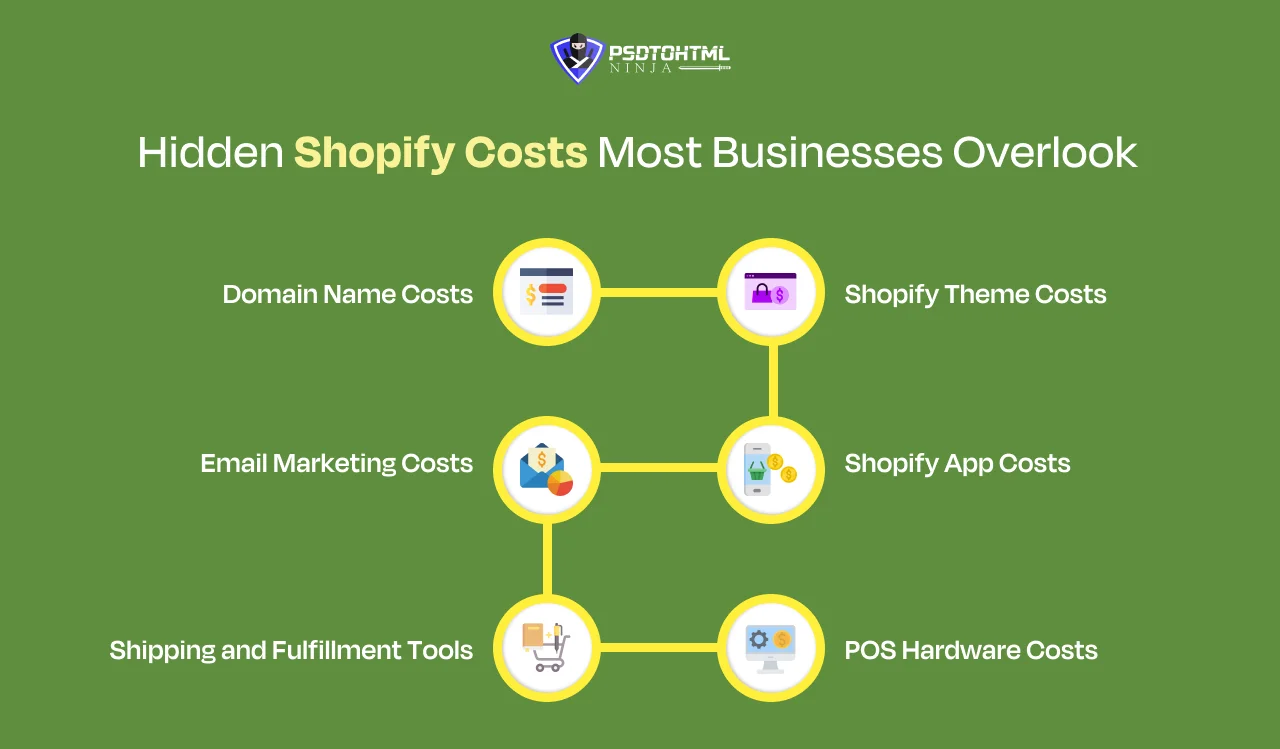
Estimating the cost of Shopify development means considering multiple stages and features directly and indirectly impacting the final cost to be paid. Apart from the subscription pricing and other fees, various hidden costs significantly impact the total pricing of developing and maintaining a Shopify store.
Businesses tend to miss these hidden costs when they are in the planning phase, only to pay an extra amount later as their store expands. Having a prior understanding of these expenses ahead of time helps in creating a more realistic budget.
While understanding Shopify pricing is important, businesses should also consider the overall cost of building and launching a store. Expenses such as custom theme development, app integrations, store migration, and custom functionality can significantly impact the total investment. If you're evaluating the full cost of launching a Shopify website, check out our detailed guide on How Much Does It Cost to Build a Shopify Store?
Domain Name Costs
Businesses need a domain name to establish a reliable online presence. A domain name can be directly purchased through Shopify or through a third-party domain provider.
A domain name usually costs from $10 to $30 per year. However, premium extensions and domain names are expensive.
Shopify Theme Costs
The appearance of your Shopify store is heavily influenced by the quality of the Shopify theme. A relatable and easy-to-navigate online store shapes the customer experience and conversions.
- Free themes: Shopify has a great range of free themes that are professionally designed, perfect for startups and small businesses. These themes come with the essential ecommerce features you need and are usually just right for stores that have simple design needs.
- Premium themes: Premium themes cost between $100 and $500 for a one-time purchase. These themes often offer advanced customization options, better performance, unique layouts, and features tailored to specific industries, helping businesses create a standout online presence.
- When upgrading makes sense: Investing in a premium theme can be a smart move if your business needs more advanced features, stronger branding, a better user experience, or improved conversion rates that a free theme cannot deliver.
Shopify App Costs
Shopify apps are one of the common cost-affecting factors that are easily ignored. They cost differently based on your store requirements.
- Product Reviews: Gathering and showcasing customer feedback to foster trust and boost conversions.
- Upselling and Cross-Selling: Suggesting related products to enhance the average order value.
- SEO Tools: Enhancing visibility on search engines and driving organic traffic.
- Loyalty Programs: Rewarding loyal customers to improve retention rates.
- Subscription Management: Facilitating recurring purchases and supporting subscription-based business models.
Email Marketing Costs
About 81% of companies use email marketing worldwide, making it one of the most popular marketing tools. Online store owners mandatorily integrate email marketing tools on their website for customer retention.
While Shopify offers some basic email marketing features, many companies choose to invest in specialized platforms that provide advanced automation, segmentation, and campaign management.
Some popular tools that work well with Shopify are Klaviyo, Mailchimp, Omnisend, and ActiveCampaign. The costs usually vary based on the number of subscribers and the volume of emails sent, with monthly fees starting around $20 for smaller stores and potentially reaching several thousand dollars for larger ecommerce brands.
Shipping and Fulfillment Tools
Large-sized Shopify stores often require additional shipping and fulfillment tools. Businesses require advanced tools to handle shipping labels, inventory levels, synchronization, and logistics integrations.
Adding these tools costs an additional amount for Shopify stores. Depending on your shipping strategy and the volume of orders, these tools can add anywhere from just a few dollars a month to several hundred dollars in ongoing costs.
International shipping leads to even higher expenses due to customs processing, duties management, and the complexities of cross-border logistics.
POS Hardware Costs
When it comes to running a business with both a physical store and an online presence, investing in Shopify POS hardware can be essential. While the software is bundled with certain plans, the hardware needs to be bought separately.
Here are some common costs associated with POS hardware:
- Card readers
- Barcode scanners
- Receipt printers
- Cash drawers
- Retail stands and accessories
Depending on your needs, the total cost can vary significantly, starting from under $100 for a basic setup and going up to several thousand dollars for larger retail spaces that have multiple checkout stations.
Real Shopify Cost Examples
Example: Fashion Store
Planning to open a Fashion store? Start with a Grow plan, which is perfect for handling a growing product lineup and increasing customer traffic. When you break it down, monthly costs can include:
- Shopify subscription (around $105)
- Premium theme (which can range from $20 to $40 if you think of it as a monthly expense)
- Apps for reviews and upselling (about $30 to $60)
- Email marketing tools (roughly $20 to $50)
- Transaction fees.
So, on average, a fashion brand's monthly Shopify expenses typically land somewhere between $180 and $300, depending on how well sales are going and the marketing strategies in play.
Example: Electronics Store
Electronics stores typically need more advanced features because they deal with larger inventories, product comparisons, warranties, and higher transaction amounts. Here is a rough cost estimate:
- Shopify Advanced plan, costing $399 a month
- Inventory management tools, product filtering apps, customer support software, and fraud prevention solutions. These extra costs can range from $150 to $500 each month,
This means that a growing electronics retailer could be looking at a total Shopify store expense of around $550 to $900 per month.
Example: Subscription-Based Store
Subscription-based businesses earn revenue through recurring billing and long customer retention. When merchants sign up for a Shopify plan, they usually also invest in various tools like subscription management apps, email automation platforms, loyalty programs, and customer analytics.
Depending on how many subscribers they have and how much automation they need, their monthly costs can fall anywhere between $200 and over $700.
Although the initial expenses might seem high, subscription stores often enjoy the perks of steady, predictable revenue that fuels their long-term growth.
Shopify vs Other Ecommerce Platform Costs
While setting up e-commerce platforms, it is crucial to think beyond just the initial costs. You also need to consider the ongoing expenses that come with running and growing your online store. Platforms like Shopify, WooCommerce, BigCommerce, and Magento each have their own pricing structures and ownership costs to consider.
Let us compare Shopify’s pricing and the total cost structure with the other available options:
Shopify vs WooCommerce
WooCommerce might seem like a budget-friendly option at first since it’s free to install, which keeps your initial setup costs down compared to Shopify. But you will need to pay for hosting, security, maintenance, plugins, and technical support separately.
On the other hand, Shopify bundles hosting, security updates, and platform maintenance into its subscription fee, which makes it easier to plan your budget.
While WooCommerce gives you more flexibility, many find that Shopify is simpler to scale because it takes care of the infrastructure management for you.
Shopify vs BigCommerce
When it comes to Shopify and BigCommerce, both platforms offer subscription-based pricing, but they have their own unique strengths.
Shopify boasts a vast app ecosystem and allows for more customization, while BigCommerce packs in a lot of advanced features right into its core plans, which can lessen the need for third-party apps.
Shopify vs Magento
Magento shines with its extensive customization options, but it does come with a hefty price tag in terms of development, hosting, and maintenance.
For many businesses, Shopify is the more budget-friendly choice, offering the scalability, security, and ease of management that are essential for long-term ecommerce success.
How to Reduce Shopify Costs
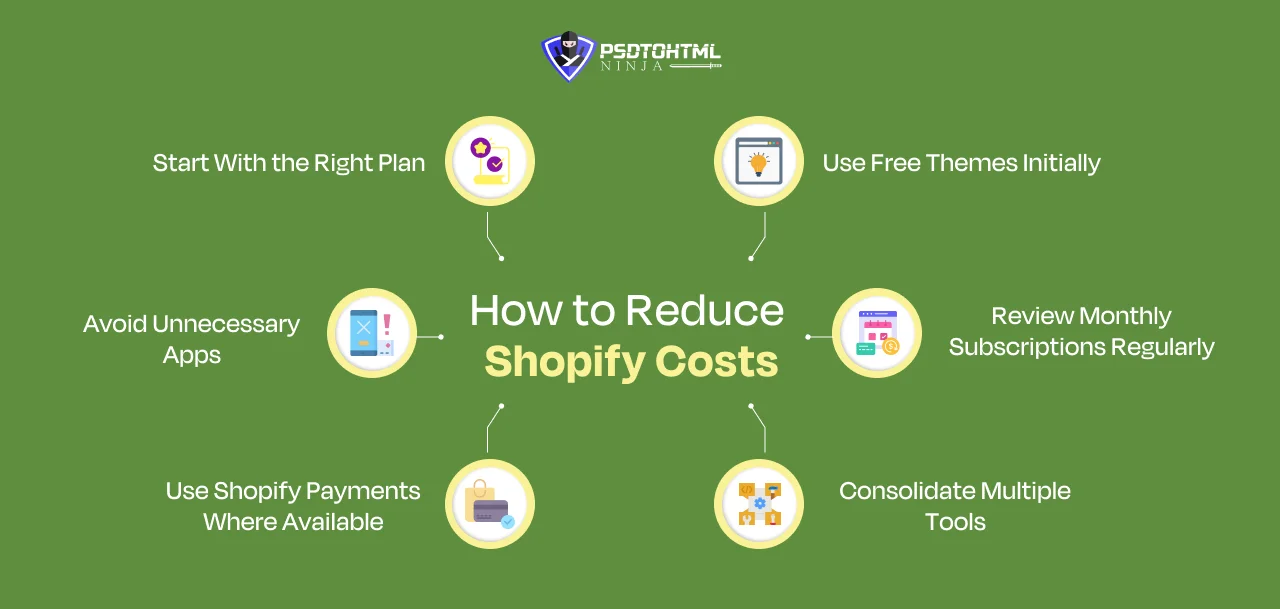
E-commerce business owners spend a fortune on setting up their online stores. From creating a website to maintaining it, the entire ecosystem comes with high subscription fees and additional charges.
What if you can actually save some money from the overall Shopify development cost? Here are some tips that can help you reduce Shopify costs:
Start With the Right Plan
Assess your requirements with great precision. Create a plan for at least the next 2 years, and then choose the most appropriate plan for your Shopify store.
Use Free Themes Initially
Startups and small businesses that have recently entered the market should start with free themes. You can always upgrade to more customizable pro themes, but free themes are enough for websites with a significantly low user base.
Avoid Unnecessary Apps
Make a list of the apps that your store really needs and only purchase the ones that are absolutely necessary. Don’t buy every other app that you find on the Shopify store. Identify your requirements and advanced analytics needs, then buy the apps that best align with your interests.
Review Monthly Subscriptions Regularly
If you are just starting out, review the monthly subscriptions of your website on a regular basis. This helps in eliminating unnecessary features and tools that you are paying for. Regularly review your Shopify subscriptions, apps, and any third-party services.
This way, you can spot features that you might not need anymore. Cutting out those unused subscriptions can really help you save a good chunk of your monthly budget, ensuring that you’re only investing in tools that genuinely help your business grow.
Use Shopify Payments Where Available
Consider Shopify payments over third-party payment gateways. Shopify Payments helps you avoid extra transaction fees, which can really add up, and save you a good amount in the long run.
Handling payments through Shopify’s own system makes reporting easier and helps keep your store running smoothly.
Consolidate Multiple Tools
A lot of businesses juggle different platforms for things like email marketing, customer support, analytics, loyalty programs, and automation. While having specialized tools can be helpful, managing too many subscriptions can really drive up costs.
Instead, try to find platforms or apps that bring multiple functions together in one place. By consolidating your tools, you not only cut down on software expenses but also make your workflows simpler and boost your overall efficiency.
Is Shopify Worth the Cost?
Absolutely! We at PSDtoHTMLNinja have served numerous e-commerce clients. Business owners often prefer the platform because it is easy to use, both by customers and the team.
Shopify stores get timely and regular security patches and updates. This keeps all the customer data and essential details completely secure.
Shopify stores also grow with your business. E-commerce brands that are aiming to scale-up in future, or the ones that have a steady business growth greatly benefit from Shopify’s advanced analytics and marketing tools.
Shopify has a large and popular ecosystem consisting of numerous plugins, themes, and easy integration of third-party tools. The platform also has a vast online community, making it a top choice.
Situations Where Another Platform May Be Better
- Highly customized projects: Shopify offers highly custom features and tools. However, its themes can be tailored to a limited point. If you want your store exactly how you imagine it, then moving to a more customizable store will be better.
Businesses with in-house development teams: If your business operates with a dedicated in-house development team, platforms like WooCommerce or Magento can give you the freedom to customize every detail of your ecommerce experience.
Unlike Shopify, these platforms let developers edit the source code, manage hosting environments, and tweak server configurations, enabling them to create highly personalized features and workflows.
However, this would mean managing most of the technical aspects on your own.
Frequently Asked Questions
1. How much does Shopify cost per month?
Based on the plan, your Shopify cost can range from $39 per month to $2300 per month. However, this amount can increase with Customization, additional features, advanced tools, and other integrations.
2. What is the cheapest Shopify plan?
Shopify’s cheapest plan is the Basic Plan that offers constant support, 10 inventory locations, abandoned cart recovery, and is designed for startups and entrepreneurs.
3. How much is Shopify for beginners?
Absolute beginners can try the Basic Plan which costs about $39 per month. You can also try the free trial from Shopify that is free to use for 3 days then $1 per month for three months on eligible plans. Post that, the regular costing starts based on the plan you chose.
4. Does Shopify charge transaction fees?
It depends on your payment setup. Using Shopify payments does not deduct any transaction fee. However, the transaction fee is charged if you use a third-party payment system.
5. What fees does Shopify take from each sale?
No fee is charged if you use Shopify payments. But the platform charges you some percentage of each sale in case you use a third-party payment setup.
The percentage is different for all the plans:
Basic: 2.9% + $0.30
Grow: 2.7% + $0.30
Advanced: 2.5% + $0.30
Plus: varies between 2.15% - 2.5% + $0.30
6. Do I need paid Shopify apps?
Shopify paid apps include marketing tools, review integration, upselling tools, and advanced analytics. These tools are usually integrated when your business expands.
7. Is Shopify cheaper than WooCommerce?
Yes, Shopify costs much lower than WooCommerce, especially for startups and small businesses.
8. How much does Shopify Plus cost?
The plan solely costs $2300 but the overall cost depends on your hosting choice, customization requirements, and payment setup.
9. Can I sell on Shopify without a paid theme?
Yes, free Shopify themes can be easily installed and used to create a fully-functional website. It allows you to sell and display your merchandise without any hindrance.
10. What is the total cost of running a Shopify store?
The total cost depends on your Shopify plan and other factors discussed in this guide. A rough estimate would be from $50 to $2500 per month.
11. Is Shopify Worth It for Small Businesses?
Yes. Shopify is often considered one of the most beginner-friendly ecommerce platforms for small businesses because it includes hosting, security, maintenance, and essential ecommerce features within a single subscription.
Although there are additional costs such as apps and payment processing fees, many small businesses find Shopify easier to manage compared to self-hosted alternatives that require ongoing technical maintenance.
Conclusion
Shopify remains one of the most popular ecommerce platforms because it offers a flexible pricing structure suitable for businesses of all sizes. While the monthly subscription cost starts at $39, the actual cost of running a Shopify store depends on factors such as themes, apps, payment processing fees, marketing tools, shipping solutions, and custom development requirements.
Key Takeaways
- Shopify plans range from $39/month to $2,300+/month.
- Most businesses spend more than the subscription fee due to apps, themes, and operational tools.
- Transaction fees and payment processing costs can significantly impact your overall budget.
- Choosing the right Shopify plan can help reduce unnecessary expenses as your business grows.
- Planning for hidden costs early can prevent budget surprises later.
Whether you're launching your first online store or scaling an established ecommerce business, understanding Shopify pricing can help you make informed decisions and allocate your budget effectively.
If you're looking for expert Shopify development services, theme customization, migration assistance, or ongoing store optimization, PSDtoHTMLNinja can help you build a scalable Shopify store tailored to your business needs.

Prince Jadiya holds the position of Chief Marketing Officer at Psdtohtmlninja.com, where he assists organizations in overcoming web development obstacles. He is also known for him informative and engaging blog posts.
Couldn't find what you were looking for?
Let us know how we can help!